

Manuscript preparation
Template
Authors are required to use the official journal template for manuscript preparation.
References
References should be made in accordance with the current version of the APA guidelines (currently: APA, 2020).
Language
Primary language: English (required for the full manuscript).
Multilingual elements: Abstract, Insights, and Implications may additionally be provided in up to two other languages at the author’s discretion.
After acceptance
Once a manuscript is accepted for publication in Sustainability & Beyond, it enters the production process managed jointly by the ISDRS Editorial Team and PUBLIA – SLUB Open Publishing.
The production workflow includes:
- Copyediting
The accepted manuscript is checked for clarity, language, formatting, reference accuracy, and consistency with journal style. - Typesetting and Layout
Sustainability & Beyond prepares the article for publication in the journal’s formats (HTML, PDF, XML). Authors may be contacted to supply higher-quality figures or missing information. - Author Proofs
Authors receive page proofs and may correct minor errors. Substantive changes are not permitted at this stage. - Publication Agreement
The corresponding author will receive a publication agreement and sign it on behalf of all authors. In doing so, they grant ISDRS and PUBLIA – SLUB Open Publishing the non-exclusive rights to publish the article. - Final Quality Checks
Metadata, ethical statements, funding and conflict of interest declarations, and data availability are verified. - Publication
A DOI is assigned and the article is published online. The article is indexed, archived in SLUB’s repository, and included in the relevant issue. - Post-Publication Integrity
Post-publication issues are handled following the appropriate COPE flowchart, available at the COPE website: https://publicationethics.org/resources/flowcharts
After publication, authors are encouraged to update any preprints with the DOI and share the article in accordance with the journal’s open-access licence.
The types of manuscripts the journal will consider for publication
Typology of contributions
Sustainability & Beyond publishes original, high-quality scholarship that advances understanding of sustainability transformations across disciplines. We welcome empirical research, conceptual development, critical reflections, creative works, and multimedia contributions.
All submissions must include S&B Features:
- Insights: 4–5 key highlights of the article’s originality, inter/transdisciplinarity, and major findings.
- Implications: 3–5 implications for action, policy, practice, theory, or research methods. These may be provided in English plus up to two other languages.
The following types of contribution may be submitted to Sustainability & Beyond:
1. Article (Research Article)
Original inter- or transdisciplinary research contributing new evidence and/or theory with implications for sustainability transformation.
Length: 5,000 words (excluding references); preferred maximum 60 references
Structure: Abstract (200–250 words), Introduction, Methods, Results/Analysis, Discussion, Conclusion
Review: Double-anonymised
Submission Guidance: Clear research question; robust method; identifiable contribution to knowledge, policy, or practice.
2. Extended Article
Longer-form qualitative or interdisciplinary social science manuscripts offering deeper theoretical or empirical scope than standard Articles.
Length: 10,000 words; preferred maximum 100 references
Structure: Abstract, Introduction, Methods/Data, Results/Analysis, Discussion/Synthesis, Conclusion
Review: Double-anonymised
Submission Guidance: Demonstrate enhanced depth or breadth beyond a standard Article.
3. S&B Feature
High-profile scholarly or mixed-format contributions (manuscript, video, multimedia) addressing major contemporary sustainability issues with broad audience appeal.
Length: 6,000–8,000 words; or ≤15-minute video
Structure: Context, Approach/Case, Findings/Reflections, Lessons/Implications
Review: Editorial with external input as needed
Submission Guidance: Blend evidence, reflection, creativity, and transferability.
4. Perspective
Short, agenda-setting viewpoints on emerging sustainability challenges, theory, or policy.
Length: 3,000 words; preferred maximum 50 references
Structure: Context/Claim, Argument, Implications/Call to Action
Review: Editorial with expert input
Submission Guidance: Accessible, evidence-informed, forward-looking.
5. Review
Systematic, scoping, or narrative reviews synthesising the “state of the science” on relevant sustainability topics.
Length: 4,000 words; preferred maximum 60 references
Structure: Abstract, Scope/Method, Synthesis, Discussion/Recommendations, Conclusion
Review: Double-anonymised
Submission Guidance: Transparent search strategy; analytical and conceptual value.
6. Short Communication
Brief reports on work in progress, early findings, or new research initiatives.
Length: 1,500 words; preferred maximum 30 references
Structure: Brief Introduction, Methods/Concept, Core Findings, Key Implications/Next Steps
Review: Accelerated Double-anonymised
Submission Guidance: Timely, original, focused.
7. Comment
Concise, critical, and constructive commentary on articles previously published in Sustainability & Beyond.
Length: 500 words
Structure: Referenced context, Discussion/Argument, Concluding Note
Review: Editorial (reply may be invited)
Submission Guidance: Professional tone; substantive scholarly contribution.
8. Creative
Artistic and narrative works engaging with sustainability themes (e.g. poetry, short fiction, visual essays, graphic arts).
Length: Flexible
Requirements: Author’s Statement (200–300 words) explaining purpose and relevance
Review: Curated/editorial
Submission Guidance: Ethical representation; meaningful connection to S&B themes.
9. Multimedia
Research-based multimedia (e.g., Photovoice, video abstracts, podcasts) as standalone contributions or supplements.
Length: Flexible
Requirements: Author’s Statement (200–300 words); captions/transcripts; stable formats
Review: Editorial or external media review
Submission Guidance: Focus on research processes, findings, and accessibility.
10. Viewpoint
Practitioner-oriented or scholarly commentary on current events and their sustainability implications.
Length: 1,000 words; preferred maximum 30 references
Structure: Framing, Key Points, Call to Action/Reflection
Review: Editorial
Submission Guidance: Clear stance; high relevance to S&B’s mission.
11. Book Review
Critical engagement with recent books in sustainability science, focusing on their contributions to theory, practice, or policy.
Length: 1,500 words
Structure: Summary, Strengths, Novelty, Gaps/Weaknesses, Contributions
Review: Editorial
Submission Guidance: Invited or proposed.
Thematic collections / Categories
When submitting a manuscript to Sustainability & Beyond authors are asked to select one or more categories that are consistent with the content of the manuscript. For more information see Thematic Collections / Categories.
Previously published papers
Submissions to our journal may only contain content that has not been published previously. The following do not constitute prior publication and are acceptable if clearly disclosed at submission:
- Deposition of a thesis or dissertation in a university repository.
- Posting on a recognised preprint server.
- Presentation of material as a conference abstract, poster, or oral presentation.
- Publication of a short summary or media article intended for a non-academic audience.
- Expanded versions of previously published conference proceedings or translations may be considered on a case-by-case basis, provided there is clear disclosure, permission from the original publisher, and significant new content.
Authors should update any preprint versions with the DOI and link to the published article once available.
Secondary publication (for example, in another language or for a different readership) may be acceptable, provided that the original article is properly cited, prior approval is obtained from both editors, and the secondary version accurately reflects the content and interpretation of the original work.
Multiple or redundant publications
Authors must not submit the same manuscript, in whole or in part, simultaneously to more than one journal. Submitting substantially similar research to multiple journals, or fragmenting one study into several minimally differentiated papers (a practice often referred to as “salami slicing”), constitutes unethical publishing behaviour and will not be considered. For more information regarding multiple or redundant publications see "Redundant publication (or 'salami' publications)" in "Publication Ethics" on the publishers website.
Submission process
Manuscripts may be submitted at any time through the journal’s online submission system by clicking the “Make a Submission” button on the journal homepage. Authors will be guided through a straightforward step-by-step process that includes:
- Creating or logging into an author account.
- Entering manuscript details and confirming that the submission complies with the Author Guidelines and Submission Preparation Checklist.
- Preparing and uploading the manuscript file using one of the journal’s official Word templates, along with any supplementary materials.
- Confirming the submission.
After submission, authors will receive an automatic confirmation email. The editorial team will conduct an initial review and communicate the next steps. Authors may log in at any time to monitor the status of their manuscript throughout the editorial process.
Submission Preparation Checklist
As part of the submission process, authors are required to check off their submission's compliance with all of the following items, and submissions may be returned to authors that do not adhere to these guidelines.
- The text was created using the template provided in the Guidelines for Authors, which can be found at the top of this page. The editors reserve the right to reject manuscripts that have not used the template.
- The text adheres to the stylistic and bibliographic requirements outlined in the Author Guidelines and the provided template.
- The submission has not been previously published, nor is it before another journal for consideration (or an explanation has been provided in Comments to the Editor).
- Where available, URLs for the references have been provided.
- The authors adhere to the policies of Sustainability & Beyond.
- The authors agree that their manuscript is screened for plagiarism with the then offered version of Crossref's Similarity Check, currently iThenticate.
- The submission contains a statement on competing interests: authors need to declare competing interests and also must explicitly state if they have no competing interests.
- The submission contains information on how the underlying data and other material can be accessed (data availability statement).
- The authors are aware that if the manuscript gets accepted, the published article/contribution and its metadata will be distributed to various search engines, data bases, and abstracting and indexing (A&I) services.
- Moreover, its metadata (including abstract and references) will be sent to Crossref during the DOI registration process. Crossref makes all metadata available through APIs.
- The submission contains a statement on authors' contributions according to the CreDIT guidelines.
- When submitting the article, care is taken to enter all metadata in the submission form. This includes specifying all authors and their affiliation in OJS.
- The authors have read and adhere to the Artificial Intelligence (AI) Policy.
Authorship and contributorship
The author list must include only individuals who have made substantial scholarly contributions to the research and manuscript preparation. Sustainability & Beyond follows the Contributor Roles Taxonomy (CRediT), which defines 14 recognised contributor roles and provides a standardised framework for assigning authorship. During submission, the corresponding author will be asked to specify each co-author’s contributions using these categories, and all authors must agree on their respective roles before submission.
To qualify for authorship, individuals should have made a significant intellectual contribution to the conception, design, execution, or interpretation of the research, and should have drafted or critically revised the manuscript for important intellectual content. Those who contributed to the work but do not meet these criteria may be acknowledged in the Acknowledgements section with their consent.
All authors share collective responsibility for the integrity and accuracy of the published work. They must respond appropriately to any queries concerning the correctness or ethical standards of their contribution. All authors should be listed prior to peer review, and each will receive an email confirming their inclusion and agreement to the submission.
As stated in our Publication Ethics artificial intelligence tools cannot be listed as authors of a paper. For more information on the publisher’s AI policy please click here.
Group Authorship
In exceptional cases where research is conducted by a collaborative group, Sustainability & Beyond follows the authorship principles of the ICMJE Recommendations. All individuals listed as authors must meet the journal’s authorship criteria and accept public responsibility for the published work. The corresponding author must identify each individual author by name during submission. Group names may not appear as the sole author but may be noted in parentheses or in the Acknowledgements section.
Corresponding Author Responsibilities
The corresponding author is responsible for representing and speaking on behalf of all authors before and after the publication of the article.
After acceptance, the corresponding author is required to sign a publication agreement, which formally grants the publisher the right to publish the work. Before signing, the corresponding author must obtain consent from all co-authors, ensuring that everyone agrees to the terms of publication and the final version of the manuscript. Once the agreement is signed, the article proceeds through the final production stages, before it is published online.
Before publication, the corresponding author should ensure that the manuscript adheres to all Sustainability & Beyond editorial and publishing policies and that all authors have reviewed and approved the submitted version of the manuscript and agreed to the authorship list. The corresponding author must also provide written confirmation of all authors' consent to any changes to the manuscript's authorship.
After publication, the corresponding author remains the main point of contact for any queries about the published article and is responsible for informing all co-authors of any issues and making sure they are resolved in a timely manner.
Authorship Changes
Altering the author list after submission is only allowed with the agreement of all authors. This includes adding, removing, or reordering authors. Any modifications must be initiated by the corresponding author, along with a rationale for the changes and evidence of each author's consent, including any new authors. Authorship changes are subject to approval by Sustainability & Beyond.
If issues related to authorship are not resolved in a timely manner, Sustainability & Beyond might decide to reject the manuscript. However, a resubmission could be considered if the problem is solved during that time. Sustainability & Beyond might consider a resubmission if/when the authorship issue has been fully addressed and resolved.
Author Identification
Sustainability & Beyond requests that corresponding authors provide their ORCID iD during submission. While it is not mandatory, Sustainability & Beyond encourages all authors to provide their ORCID as well.
Upon acceptance of a manuscript, Sustainability & Beyond discloses all ORCIDs provided.
Sustainability & Beyond uses the Crossref-implemented automatic update feature which means that the authors’ ORCIDs will be saved and used to update the records of authors once the paper gets published.
Conflicts of interest / Competing interests
Authors must be open about any interests that could influence their work. This includes financial support, jobs, consultancies, shareholdings, or personal relationships that might be seen as affecting the research.
All conflicts of interest should be declared when submitting a manuscript. If there are none, authors should state: “The authors declare no conflicts of interest.”
Please refer to Publication Ethics for information on what and how to declare conflicts of interest.
Data sharing and reproducibility
Sustainability & Beyond is committed to upholding the principles of good scientific practice and Open Science. Our goal is to promote research that adheres to the FAIR principles (Findable, Accessible, Interoperable, and Reusable). Research outputs extend beyond traditional written works and encompass data, code, software, and other materials. To ensure transparency and reproducibility, we encourage authors to deposit all of these research outputs in a publicly accessible, FAIR-aligned public repository and provide the respective addresses in the manuscript. Whenever no ethical or legal constraints apply, authors should publish their data, code, and other materials. As a contributor to Sustainability & Beyond, we request that you provide a clear indication of the availability and reusability of your research material in a "Data Availability Statement". If research data or other research material cannot be published, for example for reasons of data protection, research ethics or copyright, this can also be indicated. Data availability statements should include information on where data supporting the results reported in the article can be found including, where applicable, hyperlinks to publicly archived datasets analysed or generated during the study.
Sustainability & Beyond offers suggested language for data availability statements (see table below). You can adapt these suggestions to suit your submission, specifying the type of research material you are referring to, such as datasets, questionnaires, transcripts, observation protocols, audio/video/image material, literature collections, archival material, or code. If none of these suggestions seem suitable for your work, you can find additional guidance and language suggestions on the Iowa University Libraries website.
|
Data availability |
Sample language |
|
Research material is freely accessible in a repository or research data centre. |
The research material used in this study is freely available in the repository/research data centre [name of repository/research data centre] under [DOI]. |
|
The research material has not been published and can be obtained from the authors. |
The datasets generated during and/or analysed during the current study are not publicly publicly available due [REASON WHY DATA ARE NOT PUBLIC] but are available from the corresponding author if there is a legitimate interest. |
|
not applicable |
No research material was generated or analysed as part of this study. |
|
Research material is available within the article or in an appendix. |
The research material generated or analysed as part of this study is included in this article and/or in the appendix. |
|
Research material is available in a repository with restricted access. |
The metadata of the research material analysed in this study are available in the repository/research data centre [name of repository/research data centre] under [DOI]. Release of the dataset can be requested from the authors under certain conditions [name of person holding rights, e-mail address]. |
|
The data is subject to third party restrictions. |
The data that support the findings of this study are available from [third party name] but restrictions apply to the availability of these data, which were used under license for the current study, and so are not publicly available. Data are, however, available from the authors upon reasonable request and with permission of [third party name]. |
|
The research material is not freely available. |
The research material will not be published for ethical, privacy or other reasons. |
The table above is adapted from the Open Gender Journal, the chart provided by Iowa University Libraries, and the article cited below and it is licensed under a Creative Commons Attribution license (CC-BY): Hrynaszkiewicz, I, Simons, N, Hussain, A, Grant, R and Goudie, S. 2020. “Developing a Research Data Policy Framework for All Journals and Publishers.” Data Science Journal, DOI: http://doi.org/10.5334/dsj-2020-005
Ethical Oversight
Any research submitted to Sustainability & Beyond must comply with high ethical standards and follow the COPE and ICMJE guidelines. The journal reserves the right to reject any manuscript that fails to meet these standards, regardless of whether formal ethics approval has been obtained.
Studies Involving Human Participants
Research involving human participants must have prior approval from an Institutional Review Board (IRB) or equivalent ethics committee and comply with the principles of the Declaration of Helsinki.
Manuscripts must include a clear ethics statement specifying:
- The name of the approving ethics committee or institutional body.
- Whether informed consent was obtained in writing or orally.
- If consent was oral, authors must confirm that this procedure was approved by the ethics committee and describe how it was documented.
Authors must ensure participant privacy and anonymity. Identifiable information (including photographs, videos, or case details) may be published only with explicit written consent from the individual, parent, or guardian.
For studies involving human groups (e.g. by race/ethnicity, age, gender, or other characteristics), authors must describe and justify the categorisation methods used and avoid outdated or potentially stigmatizing terminology.
Animal Studies
Research involving animals must comply with recognised ethical standards for animal care and use, such as the ARRIVE guidelines and relevant national or institutional regulations.
Manuscripts must state:
- The name of the approving institutional animal care and use committee (or equivalent body).
- That all procedures were performed in accordance with applicable legislation, institutional policies, and ethical guidelines.
Authors should also confirm adherence to the 3Rs principles (Replacement, Reduction, and Refinement) to ensure responsible and humane research practices.
Reporting Guidelines
Manuscripts must follow recognised reporting standards, e.g.:
- STROBE for observational studies.
- STARD for diagnostic accuracy studies.
- EQUATOR Network guidelines for other study types.
Global and Cross-Cultural Research
Sustainability & Beyond promotes inclusivity and ethical integrity in global research. Authors conducting studies in cross-cultural, international, or Indigenous contexts must ensure that local ethical standards, cultural sensitivities, and community engagement principles are respected.
Manuscripts should include a subsection titled “Inclusivity in Global Research” within the Methods, briefly describing how ethical and cultural considerations were addressed.
Where relevant, authors should confirm that research permissions, access to samples, or data collection were conducted in line with both local and international regulations.
Territorial Descriptions
In submitted manuscripts, territorial descriptions should adhere to international conventions and agreements. PUBLIA – SLUB Open Publishing and Sustainability & Beyond maintain neutrality and take no position on any claims to territory, be they explicit or implicit, made in published manuscripts, maps, or institutional affiliations.
Peer Review Process in detail
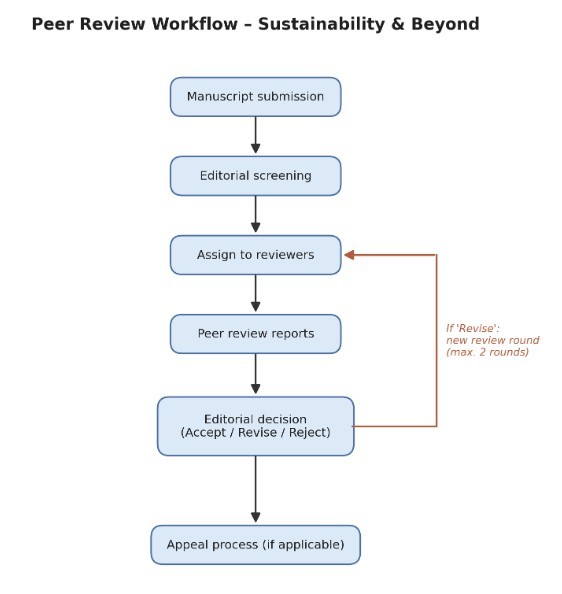
For peer review (See Figure 1 for an overview of the workflow below) Sustainability & Beyond follows a rigorous process in line with COPE Ethical Guidelines for Peer Reviewers, COPE Ethical Guidelines for Editors, and the Peer Review Terminology Initiative.
Editorial Screening
- All submissions undergo an initial editorial review to confirm scope, quality, and compliance with journal policies.
- Submissions not meeting these criteria may be returned without external review.
Review Model
- The journal operates a double-anonymised peer review system: reviewers know the identity of the authors, but authors do not know the identity of the reviewers.
- Reviewer identities remain confidential unless both parties agree to disclosure.
Reviewer Selection and Responsibilities
- At least two independent experts are invited to review each eligible manuscript.
- Reviewers must:
- Assess only within their field of expertise.
- Provide constructive, respectful, and evidence-based feedback.
Disclose conflicts of interest or third-party support (including the provider’s name). - Maintain strict confidentiality — unpublished submissions must not be shared or used for personal advantage.
- Reviewers’ assessments represent their own professional judgment.
Handling Submissions from Editorial Board Members
- Manuscripts authored or co-authored by members of the Editorial Board, including the Editor-in-Chief, are assigned to an independent handling editor with no conflict of interest.
- Such authors have no role in the review or decision process for their own manuscripts.
Reviewer Identity Protection
- Reviewer identities are protected. Pseudonyms or false names are not permitted except in rare, risk-based circumstances and only with approval of the handling editor.
Editors will remove inappropriate, disrespectful, or unprofessional comments before sending reviews to authors, without altering the scientific content.
Time Management
- Reviewers are normally expected to return reviews within 3–4 weeks.
- Editors aim to provide authors with an initial decision within 8 weeks of submission.
- Delays should be communicated promptly to ensure fairness and efficiency.
Decision-Making
- Based on reviewer comments, the handling editor issues one of the following decisions:
- Accept
- Minor revision
- Major revision
- Reject
- Conflicting recommendations may prompt the editor to seek additional expert opinions.
Author–Reviewer Dialogue
- Authors are expected to respond to reviewer comments constructively and transparently.
- Authors retain scientific freedom in deciding how to address recommendations, provided responses are reasoned and documented.
Appeals and Complaints
- Authors may appeal editorial decisions by submitting a reasoned request to the Editor-in-Chief.
- Complaints about the review process will be investigated by the editorial team and, where necessary, escalated in line with COPE Core Practices.
Figure 1. Workflow of the peer review process at Sustainability & Beyond.
For more information on Peer Review see Review Process.
Artificial intelligence (AI) tools in peer review
Peer review feedback and decision letters need to accurately reflect the opinions and assessments of the reviewers and editors. AI tools cannot replace human reviewers or editors and cannot serve as reviewers or editors.
If AI tools are used in the peer review process, including for data analysis or language editing, their usage must be disclosed to the authors in the review or decision letter.
Unpublished submissions must be kept strictly confidential, meaning they must not be processed by any third-party. This includes AI-Services which are provided by any third-party. Further, their contents must not be used to train AI, neither locally hosted nor on other systems.
Please refer to our complete AI Policy.
Post-publication discussions and corrections
Post-publication discussions
Sustainability & Beyond allows post-publication discussion through letters to the editor / a commentary and follows COPE flowcharts in handling these. If they are found to be constructive and useful to the community, they will be peer-reviewed and revised. The original authors are asked for a response or reply, which again will be peer reviewed and revised and, if accepted, both will be published and indexed in bibliographic databases.
Corrections
In certain instances, corrections may be necessary to maintain the integrity of published scientific research. Sustainability & Beyond recognizes the following methods to correct the scientific record:
Corrigendum: Minor technical errors can be corrected with the new version of the same article without notification. Otherwise, a corrigendum will be issued when a minor error is found in an otherwise reliable publication, typically due to an honest mistake. This type of correction may also be used when the author list is incorrect.
Retraction: Sustainability & Beyond adheres to the retraction guidelines set by COPE. When issuing a retraction, Sustainability & Beyond will provide a detailed note explaining the reasons for the removal.
Removal: Manuscripts can be withdrawn before publication. However, once published, articles cannot be "unpublished." In exceptional cases, such as legal action, Sustainability & Beyond may remove the full text and add a statement on the article's landing page.
Expression of Concern: In cases where editors have well-founded concerns that potentially misleading information may be contained in an article, they may consider issuing an Expression of Concern. However, this should only be done after conducting an inquiry that failed to resolve the issues and when clear indications suggest that the concerns are legitimate. It's essential to note that an Expression of Concern can harm a researcher's reputation just as a retraction can, and in most cases, it's recommended to publish a retraction only after an independent investigation reaches a definitive conclusion.
If you suspect a Sustainability & Beyond article or submission contains errors, unethical research, or other issues related to its integrity, please contact Sustainability & Beyond directly through email (journal@isdrs.org) and cc the SLUB Diamond OA-team (info@publia.org). To bring concerns to our attention, please provide the article's citation, DOI, and a clear explanation of the issue, along with any potential conflicts of interest you may have with the authors, funders, or sponsors. Sustainability & Beyond will investigate concerns raised about our submissions or publications, independent of the study's age and source.
If necessary, Sustainability & Beyond will issue a corrigendum, expression of concern, or retraction to clarify the scientific record. In cases where follow-up may be delayed or prolonged, Sustainability & Beyond may post a temporary notice on the article to inform readers about the issues raised.
While Sustainability & Beyond values transparency, Sustainability & Beyond also respects the confidentiality of individuals who raise concerns about publication ethics or research integrity. We will consider information and materials shared during ethics case discussions confidential, but may share relevant details with those involved in the case, such as editors, reviewers, or affected institutions, in accordance with COPE guidelines.
Those who raise concerns about Sustainability & Beyond publications, who participate in publication ethics cases involving Sustainability & Beyond or inquire about concerns raised to Sustainability & Beyond must adhere to our Standards for Professional Conduct (see Publication Ethics).
For queries, correction requests and other information, please contact via the editorial email address journal@isdrs.org.